Dengue continues to cause serious health problems in Indonesia. It affects nearly all provinces, with a total of over 257 000 cases and more than 1400 deaths in Indonesia in 2024. Late detection, limited diagnostic capacity, difficulties in coordination and low community participation in dengue prevention activities are challenges to prevention and response
From July to September 2025, the Ministry of Health, supported by World Health Organization (WHO) and Gadjah Mada University, led consultations to develop the “Rencana Aksi Nasional Pengendalian Dengue 2026–2029”, the national action plan for dengue. The process brought together national and subnational government agencies, professional associations, United Nations partners, academics, civil society and philanthropic organizations. They reviewed dengue trends and assessed surveillance and case management gaps. Innovations such as Wolbachia-carrying mosquitoes that are less able to transmit dengue virus, dengue vaccines, digital vector surveillance, early warning systems integrating climate and epidemiological data, and sustained community engagement were also explored.
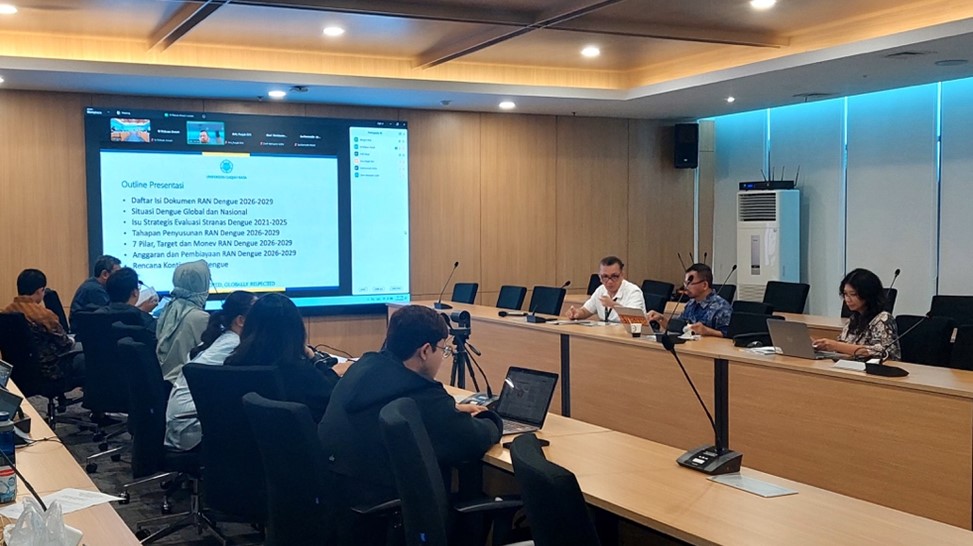 Participants attend a multisectoral consultation meeting to discuss the development of Indonesia’s National Action Plan for Dengue 2026–2029. Credit: Ministry of Health, Indonesia
Renewing government commitment, the plan synthesizes these wide-ranging inputs under pillars from vector management and clinical care to community participation and research-driven decisions. This structure aligns with Indonesia’s Health Transformation Agenda and the WHO Global Arbovirus Initiative, advancing malaria control, patient care and stakeholder involvement.
Beyond the high-level direction, the plan provides a practical roadmap to translate evidence, innovation and coordination into action. At the local level, it supports earlier detection, faster response and clearer roles across sectors. Ultimately, it helps strengthen health system resilience and protect vulnerable populations, towards the national goal of zero dengue deaths by 2030.
Written by Ajib Diptyanusa, National Consultant for Malaria and Vector-Borne Diseases, and Budiarto, National Professional Officer for HIV, Hepatitis, and Sexually-Transmitted Infections, WHO Indonesia.