Integrated surveillance and climate-informed health early warning systems
Overview
Weather and climate conditions significantly impact the incidence and geographical distribution of several diseases. Extreme weather events such as heatwaves, floods, and droughts alter disease transmission ecologies and population vulnerability, thereby influencing climate-sensitive disease risks. For example, increased temperature and rainfall induced by climate change are projected to increase the risk of malaria due to a greater geographical range for the Anopheles mosquito vector, a longer season, and enhanced vector breeding and disease transmission rates. Risk monitoring and mitigation strategies are therefore importance to preserve the health of populations.
Developing integrated, climate-informed surveillance can greatly enhance the capacity of health systems to prepare and adapt to climate-sensitive diseases. Integrated surveillance involves the integration of multiple surveillance systems (e.g. disease surveillance and weather surveillance) to improve the use of information for detecting, investigating and responding to public health threats. This integration of data, therefore, improves the flow of surveillance information through the health system.
Importantly, climate-informed surveillance can enhance the preparedness of health systems via early warning systems. Early warning systems aim to anticipate risks and trigger responses in order to prevent or mitigate outbreaks or reduce adverse impacts. In the context of a rapidly changing environment and risk landscape, early warning systems are a valuable tool for building the adaptive capacity and climate-resilience of health systems.
WHO has been implementing various projects to support countries in enhancing their integrated, climate-informed surveillance and early warning systems to improve health system preparedness and response mechanisms.
Early Warning and Response System for climate-sensitive diseases (EWARS-csd)
The WHO Climate Change and Health Unit supports countries in the implementation of the Early Warning and Response System for climate-sensitive diseases (EWARS-csd), a data-driven predictive model developed by the University of Gothenburg in collaboration with the University of Umea and WHO Special Programme for Research and Training in Tropical Diseases (TDR). A web-based EWARS dashboard has been developed to use this model to predict outbreaks of dengue, chikungunya, zika, malaria and cholera. This is a user-friendly tool that can: (i) analyse and draw conclusions from historic health datasets; (ii) identify appropriate alarm indicators – based on climatic factors and other environmental indicators - that can sensitively and specifically predict forthcoming outbreaks at smaller spatial scales; and (iii) use these results and analyses to build an early warning system to detect outbreaks in real-time and respond accordingly. Several tools have been developed to support implementation:
- A series of videos have been developed to guide you through the use of the EWARS-csd tool for climate-sensitive diseases.
- The user manual provides step-by-step instructions to implement EWARS-csd, including organising your data, using the software, and analysing and interpreting results.
- A fact sheet provides an overview of the EWARS-csd at one glance.
Key resources
Quality criteria for the evaluation of climate-informed early warning systems for...
Key Publications
All →This document presents the World Health Organization Operational framework for building climate resilient and low carbon health systems. The...
Quality criteria for the evaluation of climate-informed early warning systems for infectious diseases
The frequency of infectious disease epidemics is increasing, and the role of the health sector in the management of epidemics is crucial in terms...
Lessons learned on health adaptation to climate variability and change: experiences across low- and middle-income...
Climate change exacerbates many current climate-sensitive health outcomes and has the potential to affect the ability of health system institutions and...
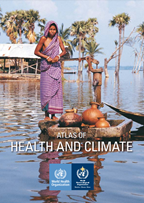
Atlas of Health and Climate
The Atlas of health and climate is a product of this unique collaboration between the meteorological and public health communities. It provides...
Public health advice on preventing health effects of heat
The most important actions to take during a heat-wave are: to avoid or reduce exposure, to communicate risks effectively, to take particular care of vulnerable...
Heat-health action plans: guidance
Climate change is leading to an increase in extreme weather events, including heat-waves. Recent heat-waves in the WHO European Region have led to a rise...
Using climate to predict infectious disease epidemics
The increased accuracy of climate predictions, and improving understanding of interactions between weather and infectious disease, has motivated attempts...
Heat-waves: risks and responses
High air temperatures can affect human health and lead to additional deaths even under current climatic conditions. Heat waves occur infrequently in Europe...
More resources


Expert meeting on using climate and weather information for predicting and preparing for cholera and...
Climate variability and change impact health risks worldwide. An important aspect of building health resilience, intersecting with strengthening health...

Heat or hot weather that lasts for several days, often referred to as “a heatwave” can have a significant impact on society, including a rise...